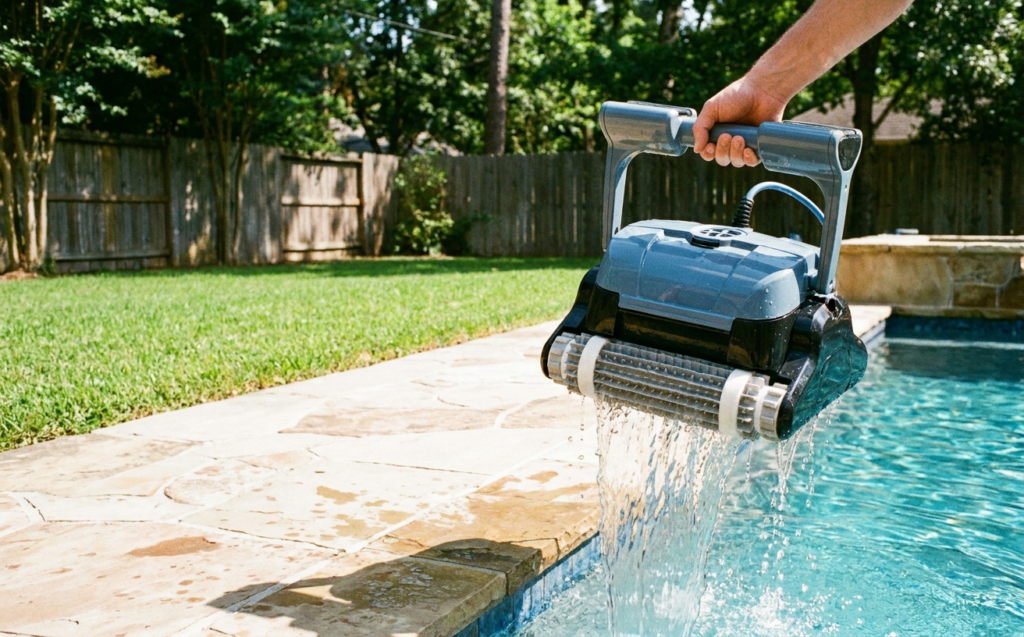

Not all pool robots are built to last. Some run well for a season and then decline. Others perform consistently for years with nothing more than filter cleaning and basic care. The difference is not always reflected in the price tag. It is reflected in the design choices that determine how the machine handles real-world conditions over time.
Knowing which features matter for longevity and which are marketing fluff helps you choose a cleaner that stays effective rather than one that becomes a source of frustration after the warranty expires.
Swivel Cable Versus Fixed Cable
The cable is the most failure-prone component on any robotic pool cleaner. It twists, it tangles, it catches on obstacles, and the internal conductors can break from repeated bending. A cleaner with a swivel cable connection allows the cable to rotate freely without twisting, which eliminates the single most common cable problem.
Fixed cables develop twists over the course of a cleaning cycle as the cleaner changes direction. These twists accumulate and eventually prevent the cleaner from reaching the far end of the pool. The only fix is to manually untwist the cable after each use, which is tedious and easy to forget.
A swivel connection costs more to manufacture, which is why it is typically found on mid-range and premium models. But the reduced frustration and longer cable life make it one of the most valuable upgrades you can get.
Filter Access and Cleaning
Every pool robot requires filter cleaning. The question is how easy the manufacturer makes it. Some models have top-access filter compartments that slide out without turning the cleaner over. Others require flipping the heavy, wet machine and removing screws or clips to access the filter.
The difference matters because filter cleaning frequency determines cleaning performance. If cleaning the filter is awkward and messy, you will do it less often. Less frequent cleaning means reduced suction, poorer cleaning results, and more strain on the pump motor.
Look for a cleaner with a filter compartment that can be accessed and emptied in under thirty seconds without tools. This is not a luxury feature. It is a usability requirement that directly affects how well the machine performs over its lifetime.
Drive Motor Durability
The drive motors are what make the cleaner move. In cheap cleaners, these motors are small, run hot, and have minimal waterproofing. In better-built cleaners, the motors are larger, run cooler, and are sealed against water ingress with double or triple gaskets.
Motor failure is the most expensive repair on a pool robot, often costing nearly as much as replacing the entire unit. Among the best robotic pool cleaners 2026 has to offer, the common thread is over-specced drive motors that handle the workload without running at their thermal limit.
You cannot evaluate motor quality from the outside, but you can look for indicators. Heavier cleaners generally have larger motors. Longer warranties suggest the manufacturer trusts the components. User reviews that mention years of reliable service are more informative than spec sheet horsepower numbers.
Pump Design and Sealing
The pump is the other critical motor in the cleaner, and it faces harsher conditions than the drive motors because it is constantly exposed to dirty water. The pump seal is the barrier between the water being filtered and the electrical components inside the motor housing.
Single-seal designs are the minimum. Double-seal designs provide redundancy: if one seal fails, the second prevents water from reaching the motor. This is a feature you will never notice until it saves your machine from a catastrophic failure.
Running the cleaner with a clogged filter increases the pressure inside the pump housing, which stresses the seals. This is why filter cleaning is not just about suction performance. It is about protecting the pump seal, which is protecting the motor, which is protecting your investment.
Wheel and Track Design
Wheeled cleaners work well on smooth surfaces. Tracked cleaners handle textured surfaces and slopes better. Neither is universally superior. The right choice depends on your pool surface.
Plaster pools with textured surfaces and slopes benefit from tracked cleaners that maintain traction on rough, inclined surfaces. Vinyl liner pools with smooth floors and walls work fine with wheeled cleaners that will not snag or damage the liner material.
The material matters too. Rubber wheels and tracks grip better than hard plastic but wear faster. The wear is gradual and not immediately noticeable, but over two or three seasons, a worn track loses traction and the cleaner starts slipping on slopes it previously climbed easily.
Programmability and Cycle Options
Basic cleaners have a single cycle: press start, and they run for a fixed duration. More advanced models offer multiple cycle options: floor only, floor and walls, quick clean, deep clean. These options let you match the cleaning cycle to the actual condition of the pool.
After a storm, you want a deep clean that runs longer and covers walls. For routine maintenance between storms, a quick floor-only cycle saves time and reduces wear on the machine. The ability to choose the right cycle for the situation extends the life of the cleaner by not running it harder than necessary.
Weekly timer functions that automatically start the cleaner on a schedule are the ultimate convenience feature. Set it once, and the pool gets cleaned without you having to remember. This is the feature that makes ownership feel effortless rather than obligation-driven.
What to Ignore
Remote controls sound appealing but add cost and complexity to a component that rarely needs manual steering. Smartphone apps are similarly unnecessary for most owners. The cleaner needs to start, run, and stop. A physical button on the power supply accomplishes this reliably without software updates or connectivity issues.
Aggressive marketing claims about suction power and coverage speed are not reliable performance indicators. A cleaner that advertises massive suction but has poor filter access and a fixed cable will underperform in real-world use compared to a simpler machine with better usability.
Focus on the features that affect daily ownership: cable management, filter access, motor quality, and cycle options. These determine whether you keep the cleaner for years or replace it after one frustrating season.